5/30/2020 10:40:56 AM

Oblivious to what the world was saying about my sudden interest in art, I immersed myself in the pursuit of art like I was an artist all along! Since I am a self-described moody person who refuses to do anything that is of no interest to me, it wasn’t until I was shown how to paint with oils indoors that I delved into making art. The frustration of waiting for oil paintings to dry, especially in the winter months, made me explore better ways of working with acrylics. Just last year, I created more than 58 paintings because I told my son I would do it to mark the 58th year of my life. This led to applying for grants and exposing my work to the world. Luckily, for me it was quite well received!
Amidst the elation of presumable success, however, the unfathomable happened. “Did you go to art school?”, “Let me tell you the basics”, “What are you trying to make?”, “Where are you coming up with these ideas?”, “Are you making these up in your head?”, “Your hypothesis is wrong”, “Everything you are talking about is already done”. While these words of unsolicited advice were a bit demoralizing at first, what the naysayers did not know was that the quiet façade I portray actually masks a feisty, thinking, fearless and inquisitive mind. As I sit here writing this blog post, I came across quite a few articles on the subject. Just google the title of this blog and you will find that many people have much to say.
So, why should I add to the debate? Because people actually said these things to me! No one has the right to question whether you are an artist or not. Keep making your art. Not everybody is as strong-willed and butt-headed as I am, so this blog is dedicated to those people who at some point in their lives were minimalized for some reason or another. Let the world decide if they like your work and keep the naysayers at bay by forging right on.
5/29/2020 8:12:58 PM
Majority of the art I create is abstract. Fall leaves is an abstract painting and is really a reproduction of a photograph I took one rainy Fall day. Our book club trip in Columbus took us to a spa off the beaten track with warm people who took care of us on a cold rainy Fall day. I can't wait to paint the realistic picture of this exquisite wonder of nature. These are just Fall leaves on a tar pathway. The vivid colors of the maple leaves were a feast to my eyes. It was a photograph I took with my trusty iPhone and manipulated it to an abstraction. Tea House in Guangzhou is also a painting of a photograph I took on my visit to China. I am a world traveler. I love to paint beautiful things. This Tea house looked like a painting to me so I painted it. Our world is a beautiful place blessed with many beautiful people. This landscape was created by people just like us. I hope we take the time to appreciate the beauty of God's creation and the creations of people like you and me. I hope my paintings will inspire us all to be more kind to each other and appreciate all that is good in this world.

Fall Leaves - Oil on Canvas by Hyacinth Paul

Halloween Mixed Media - Acrylic on Canvas by Hyacinth Paul
The question I would like to explore today is "Why should you reproduce Master Works and is there any benefit in doing so?" I have been resisting the idea of reproducing works of Masters because I always like to create my own paintings that have my ideas on canvas. I do take workshops and private lessons. Realism fascinates me and I think it is a very difficult skill to master. Most of my private lessons have been to study realism. The serious exploration of this technique started with a photograph I took in China and I painted Tea House in Hangzhou in private lessons. It took me a long time to complete it but I learnt a lot during the painstaking process.
Recently I attended a workshop on painting like Monet. It is said that Monet painted fast. He loved painting plein aire which means out in the open.
Here is the art work in progress. It took me about six hours to reach this stage.

Study of Monet Lillies Painting Take I - Oil on Canvas by Hyacinth Paul
I have since read up on how Monet painted and I will post the completed painting once it is done. You will notice that there are elements of my abstraction sneaking up on an impressionism painting. I guess every artist has a style all their own and it somehow shows up unknowingly in their works even if they are reproducing the works of a Master!
To answer the question of whether reproducing famous artworks is beneficial I will point to some of the resources that have shed some light here and here.
This would be the first painting I will be reproducing and I can’t wait to show it to you once it is complete. Having done this, I must agree with the wisdom that reproducing a piece of art makes you study the art and the artist in depth. What is seemingly an easy piece of art to reproduce becomes rather complicated once you attempt it.
5/28/2020 4:00:36 PM

I am inspired by nature and enjoy every sunset, sunrise, twinkling stars in the bright skies far from civilization, the mountains, the valleys and planet we call home. I plant a garden every spring add perennials, grow annuals from seed and add some nursery grown plants. I insist on planting these myself, while it is hard work there is something about playing in the dirt and seeing the results of your labor later in the season. This feeling remains unmatched. Some of my paintings like Amazon were done in protest of environmental disasters and then some like When Heaven Came Down to bring attention to the beauty of places some of us will never see. In an era where we are doing much harm to the environment due to our actions, I hope that art will move more people to the conservation of our blue planet. We hold the power to do our part to preserve our planet for future generations.

Amazon - Acrylic on Canvas Painting by Hyacinth Paul

When Heaven Came Down - Acrylic on Canvas Painting by Hyacinth Paul
I wanted to find out about artists and their connection to nature. The question was “Did artists draw inspiration from nature?” I did not have to look far as many artists were inspired by nature. A few quotes from some of the great visual artists, photographers, philosophers and scientists are mentioned below:
Vincent Van Gogh advised us, “Keep your love of nature, for that is the true way to learn to understand art more and more”.

Wheatfield with a Reaper - Painting by Vincent Van Gogh
“My wish is to stay always like this, living quietly in a corner of nature.” - Claude Monet
“I will do water - beautiful, blue water.” - Claude Monet

Water Lillies - Painting by Claude Monet
"Great art picks up where nature ends." - Marc Chagall

Autumn in the Village - Painting by Marc Chagall
Paul Cezanne proclaimed, "Painting from nature is not copying the object; it is realizing one's sensations. He also stated, "Treat nature in terms of the cylinder, the sphere, the cone, everything in proper perspective."

Mont Sainte-Victoire - Painting by Paul Cezanne
Picasso was greatly influenced by Paul Cezanne's work. It is said that he was moved by Paul Cezanne retrospective held in 1906 and he started using Cezanne's techniques, collaborated with Georges Braque and these eventually resulted in the invention of cubism in 1909.

Landscape in Provence - Painting by Pablo Picasso
“Have no fear of perfection, you’ll never reach it.” – Salvador Dalí

Landscape - Painting by young Salvador Dali
“You don’t take a photograph, you make it.” – Ansel Adams

Bridal Veil Fall - Photograph by Ansel Adams
Additional quotes that may inspire you to take nature as an inspiration for your creative outlet are as follows:
“The picture that you took with your camera is the imagination you want to create with reality.”
— Scott Lorenzo
“Normality is a paved road; it’s comfortable to walk, but no flowers grow.” Vincent van Gogh
“In every walk in with nature one receives far more than he seeks.” John Muir
“Nature is the best teacher.” William Wordsworth
“The earth has music for those who listen.” - William Shakespeare
“Nature does not hurry, yet everything is accomplished.” - Lao Tzu
“Colors are the smiles of nature.” - Leigh Hunt
"Preserve and cherish the pale blue dot, the only home we’ve ever known." - Carl Sagan
“Look deep into nature and you will understand everything better.” – Albert Einstein
“Choose only one master – nature.” Rembrandt
As always, stay curious and create!
Hyacinth
https://www.hyacinthpaulart.com/blog
5/22/2020 12:58:09 PM
Instead of writing an opinion blog, I thought I'd get some input from you. Tell me what you think.
The three paintings I'd like to include today are all abstracts done in acrylics.

Purple Rain - 48 X 36 Acrylic on Canvas
Purple Rain in reminiscent of a walk in a brilliant garden in light rain, only it’s raining purple everywhere! The colors in this painting are vibrant and puts a smile on your face. This painting is so colorful and is different every time you look at it. It has a fairytale quality of a place with beautiful memories and it will keep you wanting to have more. This painting will inspire you if you are having a bad day or just need a little pick me up. These are two comments I just received: “The painting looks very different from a distance and up close” and “The depth created by the textures pulls you into the painting.” This painting was done with a brush and a palette knife exploring different ways to enhance textures on the canvas.

Rhapsody in Blue II - 48 X 36 Acrylic on Canvas
Rhapsody in Blue is a series of paintings predominantly done in the color Blue. The Rhapsody in Blue II uses three colors Blue, Yellow and white to create this painting. I love the process of creating something pretty to look at and to decorate your space. I hope you will join me in my journey of art exploration by commenting on my paintings and letting me know what can be improved or what you like and don' t like about any piece of my art. In this particular piece I have used slightly different technique than in the previous painting Rhapsody in Blue I.
This painting made the top 15% artworks in April 2020 at Boldbrush Art Contest. Thank you BoldBrush!

New York State of Mind - 48 X 36 Acrylic on Canvas
New York State of Mind is an acrylic on Canvas painting developed for the physicians of New York serving the patients during the Pandemic. It depicts the chaos that still exists - in shades of orange, black, brown and ochre, the uncertainty that is COVID-19 is the randomness of the painting, the little rays of sunshine are depicted in yellow when the hard work pays off and the smiles of grateful patients lights up when they recover and go home, the red blood and invisible sweat that is shed by everyone in the front-lines, the blue suggests that even amidst the dark realities there will be blue skies ahead.
I am interested in the role of colors and their effects on people. This artwork has a strong color scheme and has textures that may intrigue a few. Textures are an important component of my paintings. I am studying the techniques utilized by different painters both current and from the past most notably Gerhardt Richter and Van Gogh. You will find several influences of the past in my paintings but I hope to give each painting of mine a different twist that is unique to me. Techniques like acrylic splatter and pour, scraping, marks created by different brushes and instruments as simple as forks, brush handles and palette knives are widely used in my paintings.
Let me know what you think.
As always, be curious and create.
Hyacinth
https://www.hyacinthpaulart.com/works
5/20/2020 12:49:58 PM

The COVID-19 pandemic has been especially devastating to the artist community. As news traveled around the world, galleries started shutting down and moving online. While many of us were in shock the first few weeks, galleries were taking unprecedented steps on a daily basis since March 3, 2020 to stay ahead of the situation.
Businesses like Google stepped up and took leadership in helping bring famous museums right into our homes. Why, even the head of security at the Picasso Museum in Barcelona stepped up to help by videotaping the collection so a virtual tour could make it available to the world at large! Virtual exhibitions for “Art in Isolation” helped artists showcase their work from North Dakota to Saudi Arabia.
Several resources to artists were generously made available through National Endowment of Arts. Emergency Grants were made available almost immediately to help artists cope with COVID -19. Adobe, Americans for The Arts and Cue Arts Foundation offer additional resources for artists. However, for the 2.1 million artists in the US, this may not be enough. The median wage for an artist, which is around $43,000 in the US, is slightly higher than that of the general population. This puts a majority of the artists in a scenario where, if they do not have a significant other sharing their daily expenses, they are prone to living paycheck to paycheck. Is it any surprise that there are protests across the country to reopen the economy? Working from home is a luxury for less than 10% of the US population. This brings us to former presidential candidate Andrew Yang’s idea for universal basic income. Of all the ideas out there, this one makes the most sense to my analytical mind to subvert what is a very grim prediction for the winter of 2020. It is a given that without contact tracing and adequate testing, the spread of the virus is a certainty. The leadership has to make recommendations based on evidence, and perhaps take a controversial stance to subvert disaster.
While everything that is mentioned about median wages applies to the general population, I wanted to focus on artists. As soon as I posted the question “How has COVID-19 affected you as an artist?”, responses started coming in. Here are a few:
"It has affected me financially but I have enjoyed all the time to work in my own projects. I'm getting a lot done but no income. I may have to close Olde masters when my lease ends in September."
“The pandemic has been a double edged sword for me. On the one hand, I have more time at home to draw and paint, as well as take my online classes. On the other hand, my job is demanding online, and the uncertainty of the situation makes it hard to focus. I have been using my art time to make dog portraits for my family and friends. It raises their spirits and lets me help people I care about through this difficult time in some small way.”
“I began seriously working and exhibiting my work as a full time artist a year and a half ago. I was so excited to see what 2020 would bring. Almost all of the artwork I sold was because I was physically at the ARTery gallery, or the Village Artisans, meeting and engaging with my customers.”
“The COVID-19 virus had an unsettling affect at the start. I had loads of time to paint, but found it very difficult to get inspired. I couldn’t get anything started let alone finished. I felt drained and fatigued. All I could concentrate on was the news. As time went on, I found solace in doing artwork. If I couldn’t control what was happening in the world, I could control what was happening in my little world!”
“It had a positive effect on my art. I work full time and travel so it was hard to find time to paint. With COVID I got to work from home and gain back the 2 1/2 hours I usually drive every day. I got to experiment lots of new things and felt my art take a fresh direction. It didn’t change what I paint. I didn’t suddenly start painting toilet paper.”
“I was at a loss at first. I’ve been a watercolor artist for 35 years. I just couldn’t get a painting going so I decided to try something new.”
“I had two commissions I was working on at the beginning of the COVID panic. I was afraid they would cancel since I sometimes take payment later in the process. But everyone has been very wonderful! I have more commissions now all at once.”
As for me, it has helped me focus on getting my art website spruced up and in this way made me super productive during the time of quarantine.
And, the work goes on!
As always, be curious and create!
Hyacinth
https://www.hyacinthpaulart.com/works
5/17/2020 1:30:25 PM
Yin and Yang is the concept of dualism and comes from ancient Chinese philosophy. It describes how opposites are interrelated.
I wanted to dwell on this subject due to the negativity surrounding classical and abstract forms of art being practiced at the same time.
The language of art representation is aptly explained here, and its various styles showcased here.
Last year I had an opportunity to visit the Picasso museum in Barcelona, Spain. It was quite a learning experience for me. The museum staff have made it available for you to get a glimpse of this Master’s works. Please be sure to take the virtual tour of the museum when you make a visit this site. The museum does a fine job giving us an online glimpse into the progression of Picasso’s artistic development. You will notice that young Pablo Picasso drew portraits, painted landscapes of his summer in Malaga, and painted his most important work The Communion, a fine example of realism that was submitted to the 3rd exhibition of the Fine Arts and Artistic Industries in Barcelona, Spain. He was competing with more established artists at that time. As you virtually walk through the museum, you will find that he even painted still life. In 1957 Picasso rendered his version of Velazquez’s painting Las Meninas while remaining true to the composition of Velazquez. I had the honor of seeing both. Here’s another good example of reproducing great works of art to reinterpret instead of copy.


The Communion - Pablo Picasso Las Meninas - Pablo Picasso
Let’s consider Piet Mondrian. He gave us Farm Near Duivendrecht and Woods Near Oele before he gave us Broadway Boogie Woogie.


Farm Near Duivendrecht - Piet Mondrian Woods Near Oele - Piet Mondrian Broadway Boogie Woogie - Piet Mondrian
Georgia O’Keefe gave us Dead Rabbit and Copper Pot and My Shanty Lake before she gave us Blue.


Dead Rabbit and Copper Pot - Georgia O’Keefe My Shanty Lake - Georgia O’Keefe Blue - Georgia O’Keefe
Mark Rothko gave us Underground Fantasy, and Untitled (Three Nudes) before he gave us Orange Red and Yellow.


Underground Fantasy - Mark Rothko Untitled (Three Nudes) - Mark Rothko Orange Red and Yellow - Mark Rothko
Willem deKooning gave us Portrait of Renee and Portrait of Elaine before he gave us Woman.


Portrait of Renee - Willem deKooning Portrait of Elaine - Willem deKooning Woman - Willem deKooning
Kazimir Malevich gave us The Running Man before he gave us Morning in The Village After The Snowstorm.


The Running Man - Kazimir Malevich Morning in The Village After The Snowstorm - Kazimir Malevich
Robert Delaunay gave us Man with a Tulip before he gave us Circular Forms.


Man with a Tulip - Robert Delaunay Circular Forms - Robert Delaunay
The Blue Rider of Wassily Kandinsky shows traces of a landscape. This was one of his early paintings.

The Blue Rider - Wassily Kandinsky
In his abstractions, Viktor Vasarely showed identifiable images in the iconic Zebra.

Zebra - Viktor Vasarely
Pollock showed no traces of realism in his early works.
Given the examples above, it is safe to state that in order to develop into a style that’s all your own, one must study and be unafraid of painting and learning the fundamentals. Your style may likely form as you work, and the yin-yang or duality of these opposing influences may create something that is uniquely yours!
As always,
Stay curious and create!
Hyacinth
https://www.hyacinthpaulart.com/blog
5/16/2020 9:27:01 PM
I don’t know about you, but it was hard for me to stay focused and do anything at all during the first few weeks of quarantine. I was consumed by sheer information overload until it made me numb. Shock turned to disbelief, questions turned into more questions and the news of increasing death counts from all around the world screamed we were in clear and present danger. It seems like we are living the 1995 film Outbreak. Is this our reality now? The medical personnel in protective gear and masks made the danger seem so real. When the virus hit my community, affecting my friends who were healthy young medical professionals, it suddenly became something that was not in a faraway land. It was here and now. The first few days were a mad rush of trying to find suppliers of personal protective equipment for the healthcare workers. Then came the dash for finding plasma donors, keeping up with the news, figuring out what and where to go in case of emergency, and staying abreast of testing kits only to be shocked that we can’t manufacture them fast enough because we do not have swabs. We found ourselves constantly watching out for signs of the infection of this inanimate particle that was finding a host to reproduce itself and cause havoc not only within our bodies, but also bodies throughout the world. We had to take charge of the situation and prepare for the long haul. For me, when reality finally sunk in, I knew I had to get out of my numb state of mind.
So, here’s what I did:
- Sought out grant applications and residencies I could apply to. Here are a few resources: a. https://www.arts.gov/covid-19-resources-for-artists-and-arts-organizations b. https://www.callforentry.org/ c. https://www.nps.gov/subjects/arts/air.htm
- Cleaned up my website. It is not child’s play to get your website up to the mark. One has to make a serious study of it in order to get eyes onto a website. It was and still is a work in progress. It will be a good subject for another blog post!
- Started a journal, aka my blog, so I can learn and communicate the pearls of wisdom in my musings. If you would like to get my monthly newsletter, I would love for you to sign up! It comes with benefits!
- Painted a bit, believe it or not, and entered daily and monthly competitions. There’s still time to enter! The following paintings snuck up to the popular entries.

Storm Chasers – 24 X 36 Oil on Canvas – Hyacinth Paul
https://faso.com/boldbrush/painting/209597

Nascent Earth 20 X 16 Oil on Canvas – Hyacinth Paul
https://faso.com/boldbrush/painting/209599

Tempestuous 48 X 24 Acrylic on Canvas – Hyacinth Paul
https://faso.com/boldbrush/painting/209600
If you like them, I could use your vote to inch upwards.
I have been busier during the quarantine than ever before, and dare I say more productive.
In my quest to see what people around the world have been up to, here is what I found:
- Read 5 tips here.
- I think every artist is an entrepreneur, so I think you will enjoy reading this article on five ways an entrepreneur can rebound after a crisis by Danny Beckett Jr. Founder and CEO of Assemble and Guest writer for Entrepreneur.com.
- Do your art and business have a mission? Why not brand your marketing to the mission? Read Myriam Sidibe’s article in Harvard Business Review on Marketing meets mission.
- Why not take the time to virtually tour these museums during quarantine?
- They say that every good artist must recreate famous works of art to learn from. Somehow, I had a problem wanting to do that, and my answer was to recreate famous pieces with a twist that would be all my own! But guess what? People are already doing this during quarantine! This put a smile on my face, and I hope it will for you as well!
As always, be curious and create!
Hyacinth
https://www.hyacinthpaulart.com/works
5/14/2020 2:19:19 PM
Every painter and creative person falls prey to “The Block”. It may be an artist’s block, a writer’s block or a musician’s block. It is okay to actually sit back and enjoy these moments of creative block. Sometimes, as bloggers we may intend to write something every day or every week, and then we slide. There are many reasons for these times of non-production. Maybe you are having a mental block to creative output, or you have other mundane things of life you have to take care of, or you are busy elsewhere. I say it’s okay to take time off during these periods. Most often you will get back in stronger than before. So, if you care to take the advice I give myself, “Don’t be too hard on yourself. There is every possibility of a burn out. Instead, focus on the task of the day and enjoy the moments off.”
Ralph Waldo Emerson said, “Adopt the pace of nature: her secret is patience.”
According to the Farmer’s Almanac, the last spring frost in Dayton, OH occurs on April 17. However, while it is spring in Ohio, Mother’s Day 2020 still saw freezing temperatures. These unexpected variations in temperature bring with them a lot more work than you bargain for! The last few days were spent bringing plants indoors to protect them from the freeze, only to lug them back outside again to plant. I plant everything in my garden. It is raining as I write this blog, so I thought, “let’s look at artists that use gardens as their inspiration!”
Aristotle famously said “Art takes nature as its model.”
Immediately one artist comes to mind: Monet. Much has been written about Monet and his gardens. If you just google the name, you will have a plethora of information to learn from. "My garden is my most beautiful work of art" – Claude Monet.
I chose this video by the Royal Academy of Arts to give you a sneak peek into the mind of the artist who really was invested in his gardens. He actually studied them and then immortalized them into his many paintings.

Bridge over a Pond of water Lilies – Claude Monet
“I am happy to be alive as long as I can paint.” - Frida Kahlo
Casa Azul, or the “Blue House”, was Frida Kahlo’s home where she was born and where she died. She tended to her gardens, adorned herself with the flowers she grew and drew inspiration from them, so much so that while she was dying she had her bed moved outside so she could see her gardens. I choose this video to give you an idea of Frida Kahlo’s home and this article to give a glimpse of her gardens.
Wassily Kandinsky was also known to love his gardens and used them in all their subtlety in his abstract paintings.
“I applied streaks and blobs of colors onto the canvas with a palette knife, and I made them sing with all the intensity I could…” – Wassily Kandinsky

Blue Mountain – Wassily Kandinsky at the Guggenheim Museum
Vincent Van Gogh found gardens to be his place of solace. He painted irises, sunflowers and the gardens of the asylum where he was recuperating. I chose this article with a close-up view of Daubigny’s Garden by Van Gogh to showcase his brush strokes in this painting.
Many artists sought inspiration from their gardens, including Dali, Matisse, Delacroix, Cezanne, Riviera, Rouault, Pollock and O’Keeffe, among others.
“Life begins the day you start a garden” – Chinese proverb
If you are indeed having a mental block, enjoy the moment and do something else. I quote: “If you have a garden and a library, you have everything you need.” – Cicero
I am going to plant my flower beds and will share pictures, or perhaps paintings, of the summer of 2020 in Dayton, Ohio!
As always, be curious and create!
Hyacinth
https://www.hyacinthpaulart.com/works
5/12/2020 9:09:56 AM

Who knew?
As the canvases started piling up and taking over my life and my kitchen space, the hardest of all realities sunk in. What do I do with all this art? It certainly loses its charm, packed tightly in a small gallery space or worse, taking over not just my home but my life as well!
I thought it was enough to create good art, take good pictures, describe the art, stay in touch with your potential buyers and fans, and create contests and clever giveaways!
As if this was not enough, I had to learn everything I could to sell art. Pick a website platform, create a website, merchandise, get social, participate in art fairs, create more great art… the list goes on.
Exasperated, I dove in.
“You have to master social media,” they said.
A little bird told me to Tweet away, Pin and then instantaneously I had to Instagram, learn SEO and write blogs! Look who’s inching up!?
To add insult to injury, I had to figure out the algorithms of google. But that’s not all! The google bots had to be pacified and cajoled into just looking into my hard work!
It’s all a game folks! Darwin was right all along. It is hands down “survival of the fittest!”
So stop complaining, chin up and figure out the “Art of the sale!”
Looks are deceptive, but this blog is purposefully short… or is it?
That’s all folks!
As always, be curious and create!
Hyacinth
PS: Tweet this stat!
5/10/2020 9:25:07 AM

Are artists more likely to suffer from mental illness, or should we say art helped them overcome and live with mental illness? I would argue it is the latter. Artists have created great art, and it helped save them whilst they were creating, albeit for a short while.
“My sufferings are part of myself and my art” – Edvard Munch
Scream by Edvard Munch is a personification of his feelings of desperation. His brush strokes and colors depicted his state of mind. Scream is something we all feel at some point in our life, hence the longevity and popularity of this painting.

The Scream by Edvard Munch
Francisco Goya’s Black Paintings – a series of dark and disturbing paintings done directly on the walls of his new apartment – were developed during a period when he was almost deaf and was very disturbed by the ravages of war. These paintings were done in black, brown, grey, ochre, gold and even a little white. Perhaps Goya could not come to terms with his state of health and suffered from anxiety of growing old.

The Mystery & Terror by Francisco Goya
Were the psychedelic kittens a coping mechanism for Louis Wain during his hospitalization for schizophrenia? These colorful kittens were a far cry from the cuddly, humorous kittens he painted for his wife, many with cigars and quizzical expressions.

Kaleidoscope Cat by Louis Wain
Paul Cezanne, who suffered from depression, made several noteworthy paintings like The Young Man with The Skull, and a few self-portraits while he was depressed.

Young Man with the skull - Paul Cezanne
Van Gogh suffered from myriad psychiatric problems, clearly depicted in many of his paintings like the Wheatfield with Crows, Starry Night, Barred Window and The Raising of Lazarus.

Wheatfield with Crows by Vincent Van Gogh
“I put my heart and my soul into my work, and lost my mind in the process” – Vincent Van Gogh

The raising of Lazarus by Vincent Van Gogh
Rothko too suffered from depression and eventually committed suicide. The color field paintings, especially Untitled #4 and Untitled depict feelings of sorrow.

Untitled #4 Rothko
Pollock was depressed as well, and his inner turmoil’s are shown in a lot of his paintings, especially No. 32, Blue Poles and The Flame.

#32 by Jackson Pollock
Georgia O’Keefe suffered from anxiety and depression. She went without eating or sleeping for long periods of time.

Dark Abstraction by Georgia O’Keefe
Agnes Martin was schizophrenic and sat on her famous bed staring at the canvas until inspiration came to her and then she would paint. She lived well into her nineties and died at the age of 92 despite her condition.

Friendship by Agnes Martin
“Beauty and perfection are the same, they never occur without happiness.” – Agnes Martin
The question of whether artistic genius is related to mental illness has been debated for some time now. Cesare Lombroso (1836-1909) wrote Genio e Follia (Genius and Madness) in 1894. Benjamin Rush the Father of American psychiatry also thought that mental illness and artistic creativity might be related. However, it is also true that not all mental illness results in artistic creativity.
Perhaps, creating art might help patients cope with mental illness.
An interesting take on the subject of art and mental illness was published by Terry Rustin. Rustin painted his patients’ feelings to understand their pain and isolation better, and called these works of his “outsider art”.
My readings and observations lead me to theorize that art really was a way these artists dealt with their psychiatric ailments, and not that they painted because of the illness. Perhaps this is one of the primary reasons why artists like Agnes Martin, Matisse, Michelangelo and Yayoi Kusama have lived long productive lives despite their bouts with mental/debilitative illness.
Yayoi Kusama’s meditative and repetitive art perhaps gives her reason to get out of bed. Creating art in all probability gives meaning to her life and please take note of the colors she surrounds herself with!
Oh, that red hair!

Yayoi Kusama - Wiki photograph
As always, be curious and create!
Hyacinth
https://www.hyacinthpaulart.com/works
Disclaimer: The photographs used in this blog have been taken from publicly available data and the author takes no credit for it.
5/9/2020 9:20:26 AM

In an era when funding in the arts is in steady decline the world over, it is crucial for us to investigate and quantify the relationship of art to the health of individuals. The hypothesis that color induces synesthesia is a direct response to how art makes me feel – joyful.
In 2016, mental & addictive disorders affected 1 billion people. Average Annual Growth Rates for Mental Health and Substance Abuse (MHSA) spending grew 43 billion between 1991-2001. 71 billion dollars were spent to treat depressive disorders which amounts to a 3.7% annual rate of increase between 1996 and 2013 as has been reported by the American Psychological Association in 2017.
The reason I believe that there is a connection between spending in the arts and mental health is not only because of what color does to my psyche but also from what I gather from published literature. Finland spends 0.47% of their GDP on Arts programs while the US spends 0.02% of their GDP. Also, the percentage of total mental health care expenditure in Finland went down from 5.5% in 2000 to 4.5% in 2010. While this relationship may be coincidental, it begs to be studied in-depth. Finland is definitely making a commitment to invest in child and community based programs to improve the outcomes most notable of which are reduced suicide rates and decreased mental health spending. Reiterating here that the average Annual Growth Rates for Mental Health and Substance Abuse (MHSA) spending in the USA grew 43 billion between 1991-2001. There are eight countries that spend more than the US on Arts programs. I would love to find out whether there is a correlation between arts spending and mental health care spending of these nations.
The disability-adjusted life year (DALY) is a measure of overall disease burden, expressed as the number of years lost due to ill-health, disability or early death. The World Health Organization (WHO) estimates that 7.4 percent of global DALYs are caused by disorders in the mental and behavioral category. Major depressive disorder accounts for 34.12 percent of DALYs in the mental and behavioral category. If more than one in four people in the US are suffering from mental and addictive disease, we must look at innovative measures to implement so we can reverse this effect or at least stunt the rise in costs associated with the increase in these diseases.
Given the above statistical comparison of art and mental health, I believe we must take a look at the influence of art in the general well-being of society. While the few words mentioned in the paragraphs above just skim through ideas which can be expanded upon, an in-depth study is warranted.
As always, be curious and create!
Hyacinth
https://www.hyacinthpaulart.com/
5/7/2020 9:21:30 AM

I am a recent entrant into the art world. I never knew it was so competitive. Looking from the outside in, it seemed to be a place where everybody was kind, supportive and encouraging. While a vast majority are beautiful people, there are some who just don’t cut it! So, how do you keep the creative juices flowing and keep the naysayers at bay?
I have dealt with it from the get-go! “Realism is not art; you might as well take photographs!” “If you want to be a serious artist, you need to just do one thing.” “You don’t have a niche.” “Do you have an education in the arts?” “Who did you learn from”? “Your technique is bad”. “Your art does not communicate”. And, worst of all – “your art is amateur”.
There are plenty of accounts of really famous people being criticized for the art they created. As mentioned in my earlier blogs, it seemed to me that anything of value today was severely critiqued, and sometimes quite brutally! Pablo Picasso was criticized for his cubist paintings, and Monet for his impressionism. During his lifetime, Van Gogh almost did not sell any paintings as they were considered amateur. Pollock was called "Jack the Dripper", and Rothko was dubbed a house painter!
So, how do you handle a naysayer?
I really do not know how the artists mentioned above handled the criticisms, and I am no expert at handling them either, but here is what I do. I create because I love the process of creating something from almost nothing. I love the transformation of a blank canvas to a colorific piece right in front of my eyes. I love the marks of brushstrokes, palette knives and other instruments like brush handles and forks that are guided by my intuition on the canvas. I made those marks, and I own them. There are spaces I leave where no paint needs to be, and that’s my decision. I am in love with realistic paintings because I know how hard they truly are to paint. I enjoy abstracts because they give me the freedom to paint what I think and leave their interpretation open to others. I love the play of pigments and their subtle interactions on the canvas. I love the stories told when colors lie next to each other.


The way I handle the naysayers is I own what I do.
My vision is not theirs, and that’s fine with me!
As always, be curious and create!
Hyacinth
https://www.hyacinthpaulart.com/
5/5/2020 9:23:18 PM
While #Patron is not trending, we must make every effort to recognize patrons of the arts. I looked up avenues of funding available to the youth of our country. We must invest in our youth first and foremost because they are the future leaders of our world. The US Presidential Scholars program was signed into law in 1964 by President Lyndon B. Johnson to recognize the contributions of our nation’s high school seniors. It took 15 years before the arts were recognized by this program in 1979, thanks to the National Endowment of the Arts. A stringent nationwide competition is held annually to select 20 Presidential Scholars of the Arts out of hundreds of young, qualified artists. However, 100 scholars are selected with a focus on STEM (Science Technology Engineering & Math) fields. I submit that therein lies a strong divide.
Why the difference?
Why do we have only 20 candidates selected in the Arts? Why are only 20 candidates deserving of this recognition in our glorious 50 states? That too, these seniors must meet the US Presidential scholar’s requirements which are quite strict in terms of testing. I will hesitantly give into this requirement. However, this is 2020 and I cannot believe that 41 years after introducing the Arts Presidential Scholars, nobody has recognized the need for equity in the visual, performing and creative arts.
It is time.
It is time to rethink our patronage of the arts, and this must come from the leadership of the highest office. #Patron will get new life if there is a movement in our country to bring the arts on equal footing with the sciences.
As always, be curious and create!
Hyacinth
https://www.hyacinthpaulart.com/
5/4/2020 1:05:26 PM

#Patron - does it exist?
I googled hashtags for patrons of the arts and guess what - it isn’t a thing! There are no hashtags for patrons of the arts. In my last blog I made a case for patrons and their role in the lives of artists. I extrapolated the role to society as a whole. I believe everyone can become a patron of the arts. It is not a privilege restricted to the rich and famous.
Today I’d like to shed light on Michelangelo and Pope Julius II. A very long time ago, I watched a movie The Agony and the Ecstasy based on the relationship of Pope Julius II and Michelangelo. It moved me a lot. I enjoyed the movie and it made me appreciate the Sistine chapel that much more, because it brought to life the struggles and the vision of the artist and the patron.
It is said that Irving Stone - the author of the book the movie was based upon - went to Italy for inspiration. He walked in the steps of Michelangelo Buonarroti and apprenticed in stone quarries before writing the book. The novelist referenced 450 letters written by Michelangelo in order to come up with the final biographical novel. The rights of the novel were sold to Fox, but surprisingly the studio lost close to 5.3 million dollars post production. It was heavily criticized for many reasons, but the point I am trying to make is, if not for Pope Julius II, we would not have the famous Sistine Chapel ceiling. Instead, it would be painted blue with gold stars! Michelangelo was a sculptor who painted his vision that still mesmerizes people, 500 years later to this day.
I submit that artists cannot create without patrons. Local schools and colleges are hurting to attract gifted students into the arts. They refuse to study art because "art does not pay". I think we have a problem brewing.
As always, be curious and create!
Hyacinth
https://www.hyacinthpaulart.com/
So, how can we address it? In my view, area businesses and community members must band together to encourage a prolific artistic environment in their community. We need patrons of the arts, and they must exist in communities all around the world. What we as artists need to do is give our patrons the recognition they deserve.
5/3/2020 1:04:01 PM

Humans have been making art since prehistoric times. Sometimes I imagine how those marks were made, some over 700,000 years ago, and marvel at the tenacity of archaeologists who dig up this evidence for us. Perhaps, back then, people had a lot of time on their hands and experienced joy in the creative process. It is a matter of opinion whether life was simple then or simpler now. I wonder if artist’s had patrons then.
History teaches us that great art was made because of the patronage of people of influence, resources and status in society. The process of creating art, regardless of whether it is a painting, a piece of music, a sculpture or a monumental building takes time, tenacity, intelligence and the undying belief the artist has in his or her own abilities. Many a time, the artist’s genius may only be recognized by a man as crazy as the artist himself.
Now that I have crossed over from the left- to the right-sided activities of my brain, I am more aware of the importance of these sometimes unsung patrons because of whom we are able to witness the genius of the greats in music, art and architecture.
On our recent trip to Spain, we had the privilege of visiting some architectural wonders. I had never seen anything like the works of Antoni Gaudi a Catalan, a devout catholic and genius from Spain. Instantly, I was in love, in awe and wonder-struck all at once as we visited one site after another. I wanted to travel back in time and get into this brilliant mind to learn how he thought and where his ideas came from. He was known to be gruff, did not conform to the norms of society and had a mind of his own. As I read and learn about artists, I find that many of them were criticized and ridiculed for their thought process and creations. As the story goes, when the owner of Casa Mila was shown the building upon completion, she hated it, was very upset and cried even, yet continued to live in the building. It is said that when Gaudi was commissioned to build anything, it was understood that he would build it his way or the highway. The building that was a site of ridicule and a butt of jokes then, today stands as a world heritage site.

At the sight of the Sagrada Familia – Antoni Gaudi’s magnum opus – suffice it to say I was brought to tears by the sheer grandeur and beauty of the building and its design. The construction of this magnificent church started in 1882 and is planned to be completed in 2026, the 100th death anniversary of the architect of this exquisite temple. We made a promise to visit it again.

The point of this story is that Gaudi could not have created his masterpieces without the support and patronage of his patrons. Eusebi Guell deserves special recognition, for he essentially gave Gaudi a blank check to fuel his creativity. If it were not for him, we would not have The Sagrada Familia or the Park Guell.

It is therefore the responsibility of society to support the artists who create the art. It should not be restricted to the elite in New York, London or Paris, but should percolate everywhere, in little towns and big villages. You never know from whence another Gaudi or a Giotto might grace our presence.
As always, be curious and create!
Hyacinth
https://www.hyacinthpaulart.com/
5/1/2020 4:32:15 PM

The following paintings have been submitted to an online monthly art competition conducted by BoldBrush, the company that was created by a gallery owner who helps artists sell their art through several platforms including creating websites and marketing.
I chose to send three of my paintings that differ considerably in artistic styles.
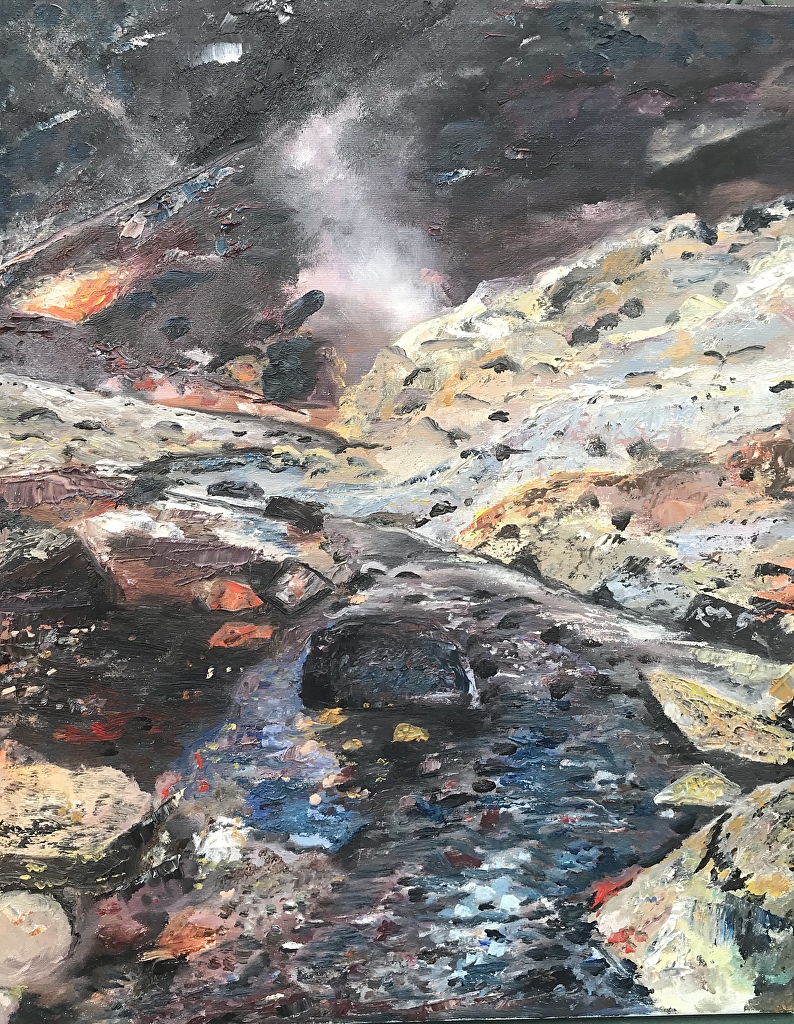
Nascent Earth is an original oil painting of a photograph from one of my travels to Iceland. Let me know what you see. It is exactly as the name suggests. The reason why this landscape painting of Iceland is named Nascent Earth is because you can imagine what earth would have looked like in the beginning. The crystal clear waters are deceptively beautiful, unpolluted and are flowing with reckless abandon over the rocks. Notice the rocks are not all rounded – some still have jagged edges. It probably means the waters here have not flown this way for centuries. The heat emanating from the ground below is heating this water, and steam arises from the ground and is visible in the horizon. The colors of the sky are reflected in the waters in the foreground, and seem almost surreal. It is not something we see every day. The hills behind are devoid of any plantation and are dark and dreary. The light, almost cream-colored silicic rock called rhyolite sticks out in sharp contrast to the dark basalt in the background. Icelandite is seen as the grey, pink and yellow rocks in the painting. You will also see interspersed several red colored rocks that are rich in iron. The brown rock is a result of oxidation when the iron and sulfur react with atmospheric oxygen. If you could smell this painting, you would get a whiff of pungent hydrogen sulfide gas emanating where the sulfuric acid is dissolving the basaltic rock, resulting in the grey colors of this landscape. Iceland is quite the experience, and the beauty in the landscape has to be seen to be believed.
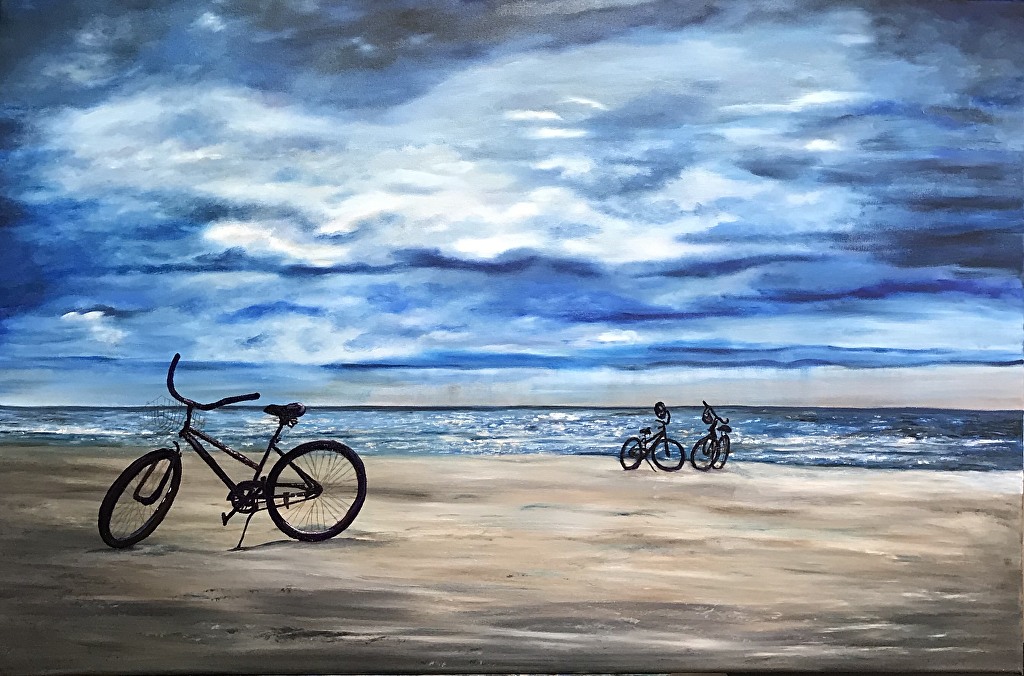
Storm Chasers is an oil painting done on canvas. This is a painting inspired by a photograph taken by my friend Dr. Prashanth Kumar. I have always been an admirer of Dr. Kumar's photography, which consumes him outside of his practice of endocrinology. I loved the tumultuous sky in this particular photograph. I love the composition. It reminds me of the movie Twister and the scientists going into the storm to study tornadoes. This is the inspiration for the title of my painting, Storm Chasers! I used some sparkly oil paint, generously donated by Cecilia Brendel, for the waters in the sea. In the distance, if you look carefully, rain is coming down and the clouds are coming in quite menacingly. If you could hear the painting, I am sure you would hear the raucous thunder that would send many a soul to take refuge. So the question is, where did the owners of these three bikes go? Obviously they must be chasing the storm! I will be painting some more of Dr. Kumar's photographs of the waters he captures during his world travels in a series called "Prashanth".
"Nature is our greatest teacher of surrender, of allowing, of simply being." - Alexandra Domelle
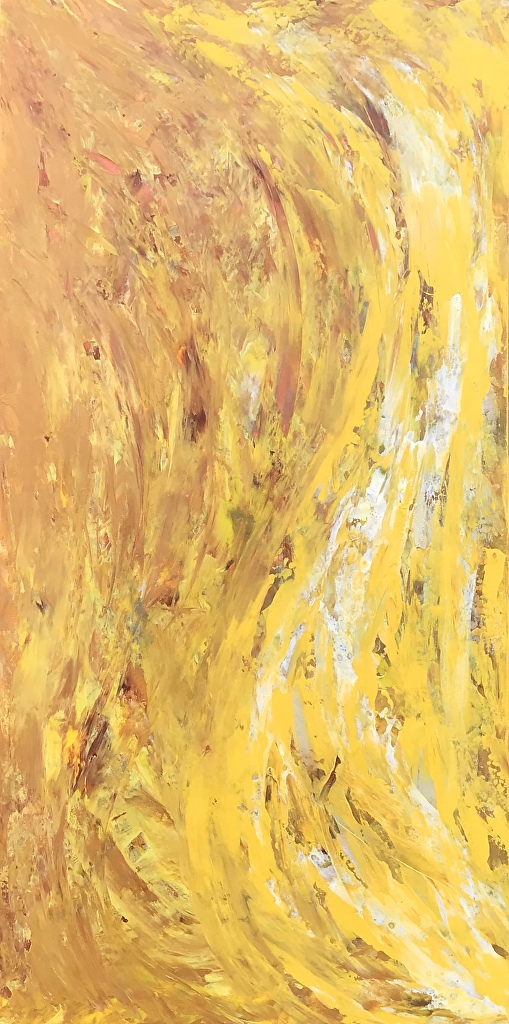
Tempestuous is an acrylic on canvas painting and it was done as part of a series on color studies in my studio. Tempestuous is an abstract painting in yellow ochre, lemon yellow, raw umber. I just like the movement in the painting, and initially I was going to call it tempest but the attitude of the painting is tempestuous to me! It may be that clouds are moving and the setting sun is casting a golden hue on them, but the winds are causing a tempest. It's almost like the clouds are playing with the wind, and the resulting tempestuous relationship of the wind and the clouds is captured in this sunlit painting.
I am interested in the study of color, the emotions they generate in people, and also the act of painting itself as a conduit to focus and possibly heal people. I strongly believe that color has a positive effect on the general health and well-being of individuals. Associations of the impact of art on the health of individuals abound, but we need to quantify it. The quantitative effects of the color in art can be studied by utilizing the recent advances in measuring the response of various stimuli to a human. So why not color?
I've designed a simple 20 item questionnaire so I can begin to collect data regarding color and my hypothesis that "color induces synesthesia and creates feelings of joy." Please feel free to fill out this survey. The benefit for you would be to enter a drawing for a chance to win one of my original paintings. For me, I get to study the effect of color in art on the general population! A win for everybody!
Kandinsky has famously said, "Color is a power which directly influences the soul. Color provokes a psychic vibration. Color hides a power, still unknown but real, which acts on every part of the human body."
I submit it is time to study this “unknown effect” of color on the human body.
Please note that the sale of this original art will generate funds for The Leukemia & Lymphoma Society (LLS) to help raise money for ground breaking cancer research. I was introduced to the work of LLS in 2017. This organization that has climbed up 30 points in one year to position 36 on the Forbes charity navigator. It is run by highly competent scientists and physicians some of whom who I have personally met. They believe they can cure cancer within our lifetime, and I agree. Study and look at the progress they have made since their inception nearly 70 years ago! The cure rate of blood cancers in 1960, the year I was born, was 3%. Today it is 94%. The research continues to happen at a feverish pace all over the world to bridge that gap. I raise money for Aparna who sadly lost her fight to cancer. We are losing many more as we speak whose lives have been cut short by these dreadful diseases. Just within the last week we have lost two of the greats, Irrfan Khan and Rishi Kapoor, to this deadly disease. Every life is precious. It is our responsibility to help fund the fight and propel discoveries. We are the product of such discoveries. We enjoy a longer life expectancy because of the discoveries of people who came before us. I am a product of scholarships that were provided to me when I was a young, bright-eyed, enthusiastic PhD student who put in nearly 15 hours a day toward research. So I ask you unabashedly, on behalf of these scholars who toil, to help find those discoveries that will finally beat cancer.
Dr. Lou DeGennaro said "It’s our job to cure blood cancer and put the society out of business."
Everyone has a cause they support. LLS is mine because I believe in them. To contribute, you can either buy a painting or any of the products associated with the painting that are provided in the links. 100% of the profits are pledged to LLS through Jun 05, 2020.
If you choose you can make a donation in the link below and no donation is too small.
https://pages.lls.org/mwoy/soh/daytonlls20/hpauldey
As always, be curious and create!
Hyacinth
https://www.hyacinthpaulart.com/